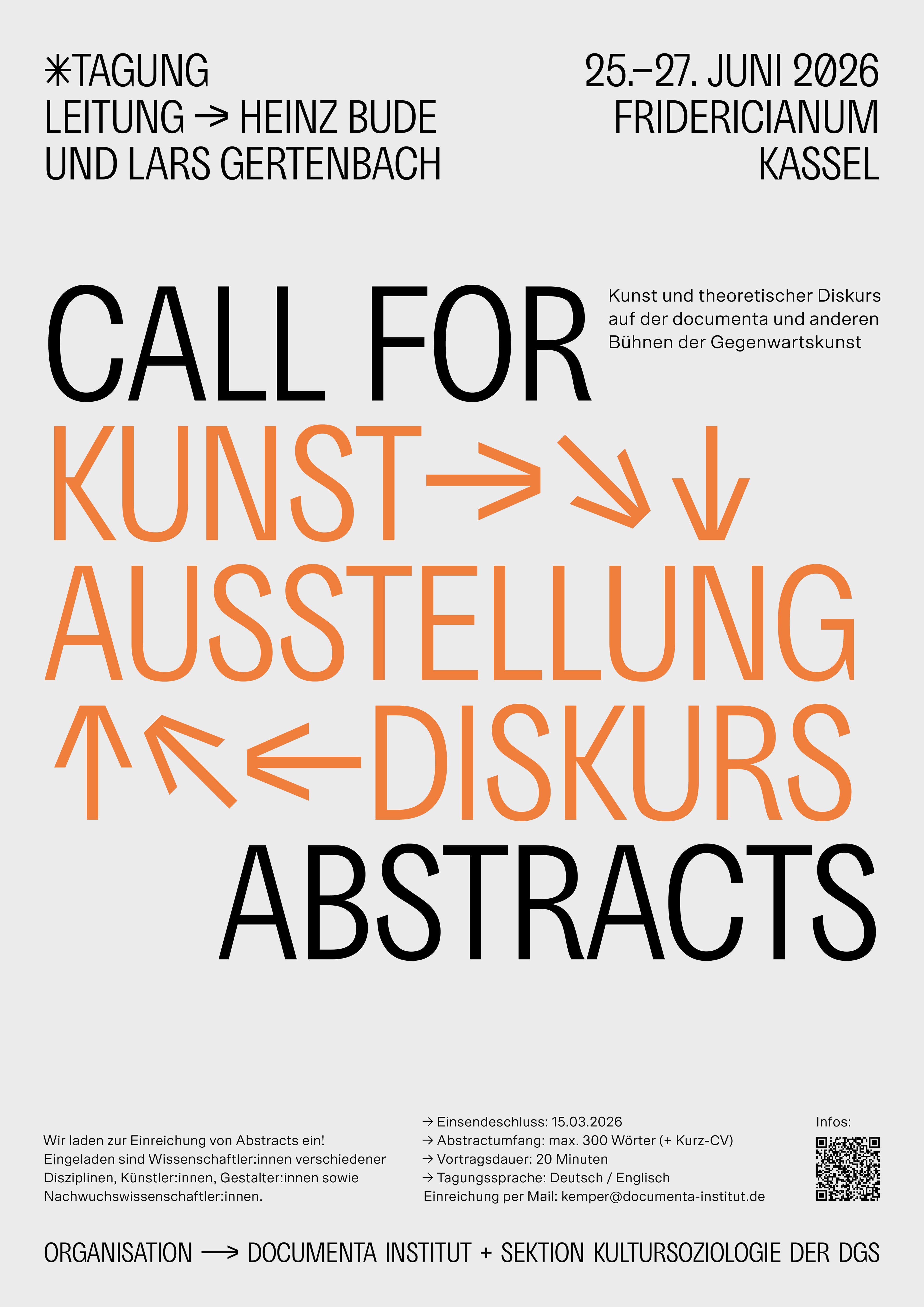
Call for Abstracts: Kunst – Ausstellung – Diskurs
Art and theoretical discourse at documenta and other contemporary art venues
We invite scholars from various disciplines, artists, designers, and early-career researchers to submit their abstracts!
About a year before the opening of documenta 16 (2027), the conference will examine the relevance, functions, and uses of theoretical discourse at contemporary art exhibitions. Naomi Beckwith, director of the upcoming documenta, most recently curated the exhibition "ECHO DELAY REVERB" at the Palais de Tokyo in Paris, which traced the far-reaching influence of so-called "French theory" on American art. She argues that this theory was not only received linearly, but also changed and productively misunderstood in the course of its artistic translation.
The documenta had already made the "discursive turn" 30 years earlier, when French curator Catherine David conceived documenta 10 (1997) as a book in the form of an exhibition, bringing theoretical discourse to the center of the world art exhibition for the first time. With the lecture series "100 Days – 100 Guests" and the more than 800-page accompanying book "Politics / Poetics", which also contained numerous texts by French authors, this edition of documenta was transformed into a long summer of theory.
While David found unused tools for her curatorial practice in theoretical discourse, especially in poststructuralist and postcolonial approaches, Beckwith recognizes these same theories as already deeply embedded in the contemporary (US) art world. As a result, theories often only unconsciously accompany activist art practice today. The explicit recourse to theories consists in part of a permissive combination of different figures of thought and the loose and sometimes erratic-seeming adoption of buzzwords that seem to serve primarily to legitimize oneself.
No documenta today can do without theoretical discourse. Bruno Latour, for example, was a key inspiration for documenta 13 (2012), and documenta 15 (2022) would be inconceivable without the decolonial impulses of Edward Said, Gayatri Chakravorty Spivak, and Walter Mignolo. Since the 1990s, exhibitions of contemporary art have not only become platforms for discourse, but have themselves become part of the theoretical discourse. Conversely, since the late 1970s, an aestheticization of theory has been observable, exemplified by the journal Traverses published by the Centre Pompidou, in which theoretical texts were combined with photographs and archival materials to create an art object. The affinity of art for theory corresponds, in a sense, to the affinity of theory for art.
Conference
From June 25 to 27, 2026, the conference "Art – Exhibition – Discourse" will therefore examine the mutual intertwining of art and theoretical discourse, as well as the associated attractions, inspirations, and appropriations. The aspect of the exhibition functions here as a hub, as a mediating instance between art and discourse, between aesthetics and theory, between performance and reflection. The conference is thus dedicated to this interlocking of art and theoretical discourse, taking documenta and other central stages of contemporary art in particular as examples of the tension between aesthetic forms and theoretical discourse.
Venue: Fridericianum, Friedrichsplatz 18, 34117 Kassel
Conference languages: German, English
Thematic focus
Theory in the field of contemporary art: influences, functions, and appropriations
To what extent do theoretical approaches shape contemporary art? How are these theories adapted, transformed, or questioned in different regional and institutional contexts, such as documenta?
Aestheticization of theory
To what extent can we observe an aestheticization of theoretical discourse, in which theory is no longer conveyed exclusively in text-based, monographic formats, but in visual, spatial, or exhibition-related media? How do the form, reception, and authorization of theory change when it is combined with images, archival materials, or creative processes and takes on an art-like form? And how does this transformation of theoretical discourses relate to the simultaneous theorization of art?
The production and circulation of discourses at and through art exhibitions
To what extent can art itself generate theoretical discourse, and what aesthetic, curatorial, or participatory strategies do artists use to achieve this? How do exhibitions of contemporary art function as magnets and disseminators of discourse?
The documenta Institut and the DGS Section „Cultural Sociology“ invite researchers, artists, and interested parties to submit short abstracts dealing with these and other questions concerning the relationship between theoretical discourse and art, the theorization of art and discourse production through art, the aestheticization of theory, and the exhibition as a mediating instance. The conference is aimed at scholars from various disciplines, such as sociology, philosophy, art history, cultural studies, history, communication and media studies, as well as artists and designers. This call is also aimed at emerging scholars, such as doctoral students. Cross-disciplinary and theory-focused contributions are just as welcome as empirical case studies. Presentations should not exceed 20 minutes. Travel and accommodation costs are subsidised.
Organization: documenta Institut (Prof. Dr. Heinz Bude, Michael Flörchinger, Marius Kemper), Section „Cultural Sociology“ in the DGS (Prof. Dr. Lars Gertenbach)
Deadline for abstracts (+ short CV): March 15, 2026
Abstract length: max. 300 words (excluding bibliography)
Submission: kemper@documenta-institut.de